
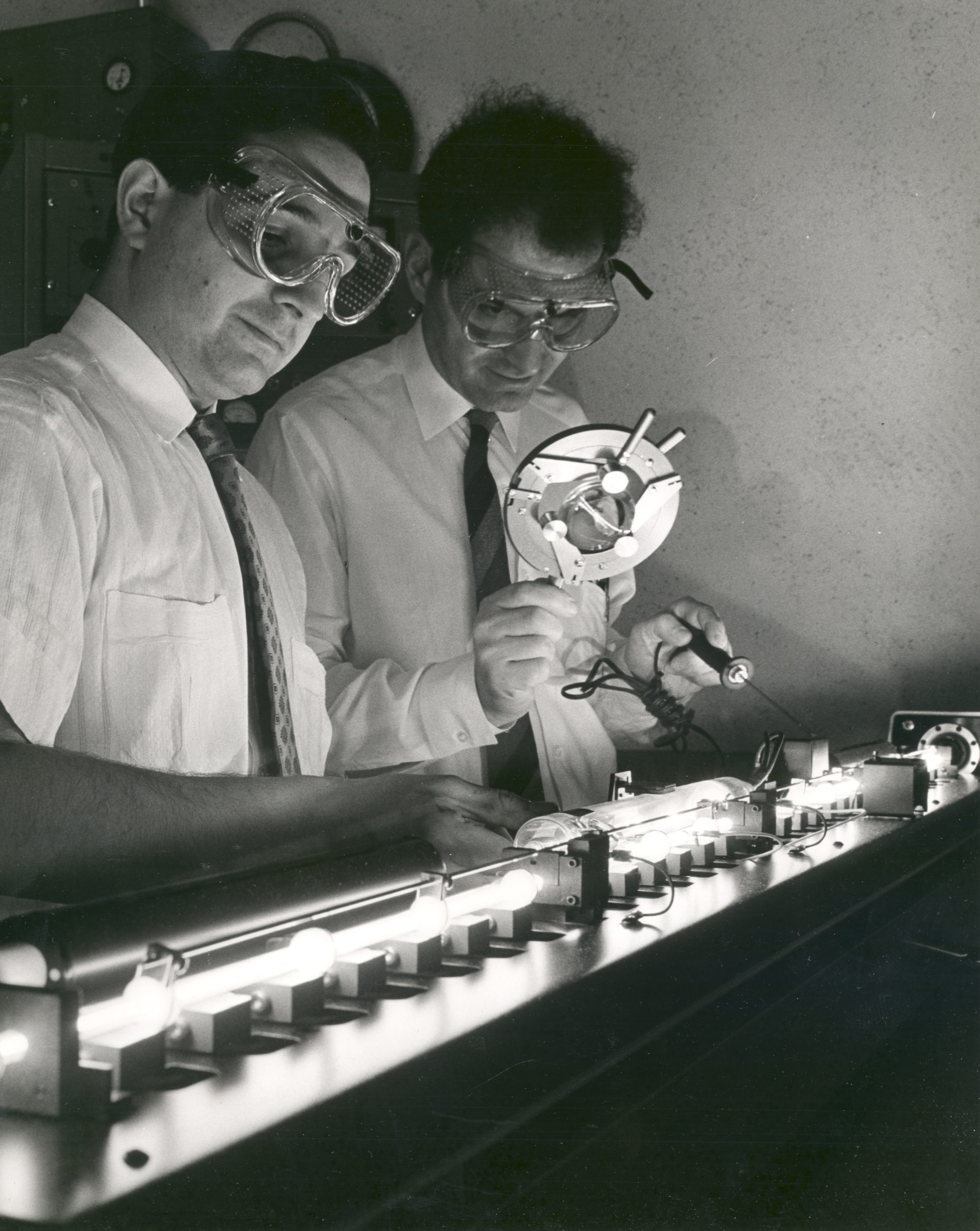
For more than half a century, the physical foundation of digital storage has relied on magnetic induction and solid-state charge traps. However, as artificial intelligence model training clusters and real-time inference data centers expand, traditional storage drives are running into an inescapable thermodynamic ceiling: electrical resistance generates immense heat, and physical magnetic switching is fundamentally sluggish.
In a groundbreaking paper published in the peer-reviewed journal Nature Communications, electrical engineers and materials scientists at the University of California San Diego revealed a viable pathway to eliminate this bottleneck: writing digital bits directly with coherent, shaped laser light pulses.
Overcoming the von Neumann Thermal Bottleneck
Modern data centers dedicate up to 35% of total facility power solely to cooling compute and high-density NVMe drive arrays. When conventional magnetic drives write data, external electromagnetic coils must generate localized magnetic fields to align atomic spins. This mechanical and inductive process requires several nanoseconds per operation and bleeds energy as parasitic heat.
The UC San Diego research team demonstrated that by directing ultra-short femtosecond optical pulses onto engineered ferromagnet-dielectric heterostructures, they could trigger an all-optical spin reversal (AOS) in less than 200 femtoseconds—over 1,000 times faster than state-of-the-art magnetoresistive RAM (MRAM).
The Physics of All-Optical Switching (AOS)
Rather than pushing an electric current through tiny metallic lines, the photonic storage cell absorbs specific wavelength laser pulses that temporarily disrupt the exchange coupling between sublattices in the magnetic alloy. In an instant, the angular momentum transfers between electrons and phonons, flipping the magnetic state from binary 0 to 1 without requiring any external magnetic field.
"By tailoring the pulse shape and polarization of the light beam, we can manipulate nanometer-scale magnetic domains at the speed of photonics, opening an era of memory chips where light is both the carrier and the writer of digital information."
Skyrmions and Neuromorphic Integration
In parallel research published in Nature Nanotechnology by Johannes Gutenberg University Mainz and the Norwegian University of Science and Technology (NTNU), scientists captured real-time Lorentz microscopy video imaging of magnetic vortex particles called skyrmions melting and recrystallizing on silicon substrates.
Because skyrmions behave like nanoscopic whirlpools of magnetism that can be nudged with tiny photon currents, researchers are combining photonic switching with skyrmion arrays to construct neuromorphic memory chips. These chips simulate the synaptogenesis of the biological human brain, allowing associative memory retrieval while consuming a mere fraction of the power demanded by traditional DDR5 or HBM3e modules.
Timeline to Commercial Foundry Production
While lab demonstrations have verified non-destructive write cycles across hundreds of millions of iterations, bringing photonic storage to commercial foundry production requires integration with standard CMOS manufacturing. Joint test programs with leading semiconductor fabrication foundries are currently focusing on integrating micro-ring silicon laser waveguides onto standard 3nm and 2nm wafer nodes, with initial enterprise SAN deployment targets projected by late 2028.
Primary Scientific Literature & Verified Citations
The experimental findings, physical mechanisms, and laser parameters documented in this article originate from peer-reviewed scientific papers: