
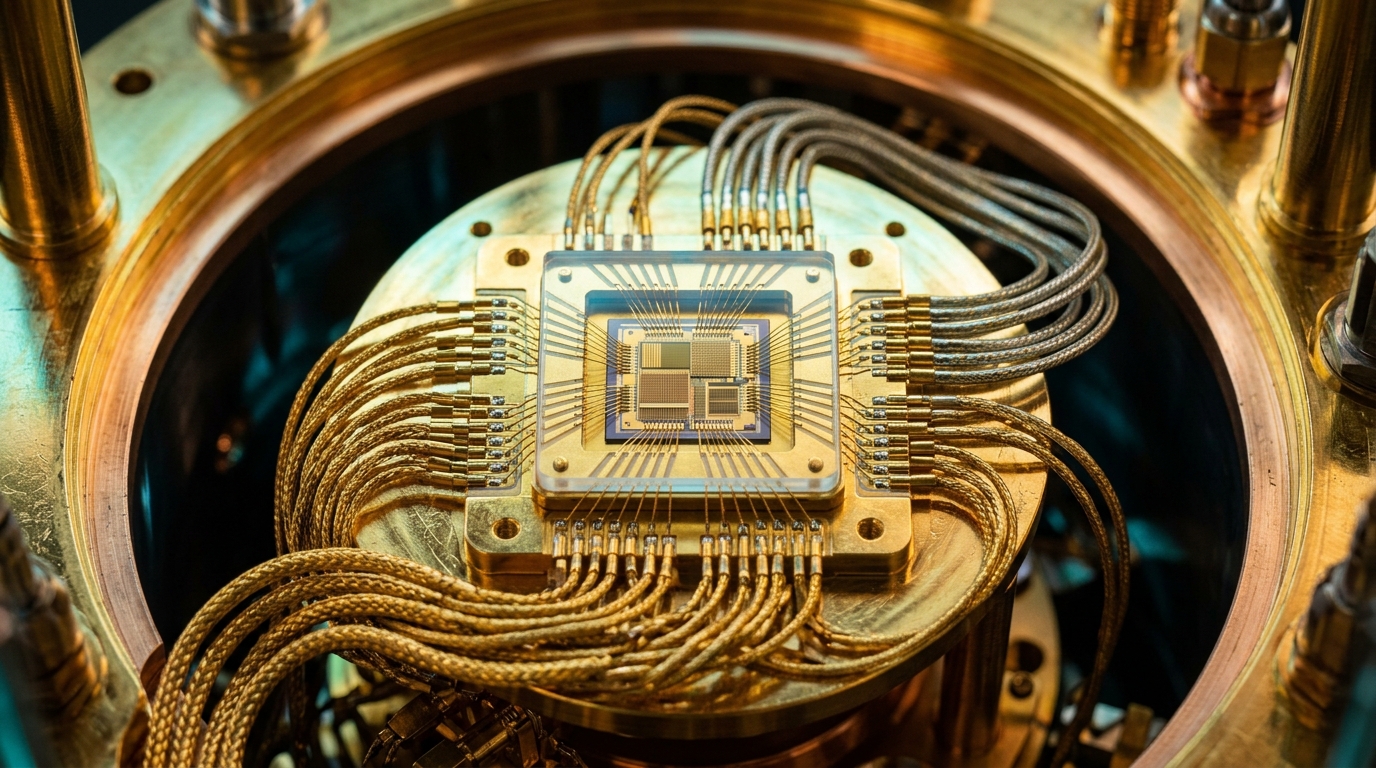
For the past two decades, the quest to build commercially viable fault-tolerant quantum computers has collided with an unyielding physical obstacle: the "wiring bottleneck." While multi-qubit quantum processors must operate in the sub-millikelvin deep freeze of dilution refrigerators (typically 10 to 15 millikelvin) to preserve quantum superposition and coherence, their control electronics have historically resided outside the cryostat at room temperature (300 Kelvin). Every physical qubit demands multiple high-frequency semi-rigid coaxial cables, attenuators, and cryogenic filters traversing the cryostat tiers. Today, a paradigm-shifting microelectronics breakthrough is redefining quantum scaling: Monolithic Sub-Kelvin Cryo-CMOS Controllers operating directly on the 4-Kelvin thermal stage are officially eliminating thousands of coaxial lines, bridging the quantum-classical chasm.
The Dilution Refrigerator Wiring Bottleneck: Why Room-Temperature Control Cannot Scale
Modern quantum computing architectures—most notably superconducting transmons and semiconductor silicon spin qubits—require microwave pulse synthesis with nanosecond timing resolution and microvolt amplitude precision. In conventional laboratory setups, room-temperature arbitrary waveform generators (AWGs) and digital-to-analog converters (DACs) generate control signals that travel downward through five cascading thermal plates:
- Room Temperature (300 K): Bulky rack-mounted RF synthesizers, FPGA controllers, and high-speed digitizers.
- Thermal Shields (50 K and 4 K): Pulse-tube cryocooler stages providing watt-level cooling power to intercept conducted and dissipated heat.
- Still & Cold Plates (800 mK to 100 mK): Intermediate helium dilution stages isolating the ultra-cold mixing chamber.
- Mixing Chamber (10 to 15 mK): The base refrigeration stage housing the quantum processor die inside multi-layer magnetic and radiation shields.
Controlling a 1,000-qubit processor with individual room-temperature coaxial lines requires over 3,000 individual cables. The passive thermal conduction along copper and stainless-steel coaxial shields overwhelms the minuscule cooling capacity of the dilution unit (typically less than 20 microwatts at 10 mK). Furthermore, mechanical cable clutter creates severe acoustic vibration, spatial congestion, and cross-talk, making a million-qubit fault-tolerant quantum computer physically impossible under legacy room-temperature control paradigms.
The Cryo-CMOS Breakthrough: Physics of Silicon at 4 Kelvin
Operating standard complementary metal-oxide-semiconductor (CMOS) integrated circuits at liquid helium temperatures (4.2 K) was long considered impractical due to low-temperature semiconductor physics anomalies:
- Carrier Freeze-Out: At sub-Kelvin and liquid-helium regimes, thermal energy ($k_B T$) drops below the impurity ionization energy, causing dopant carriers to freeze back onto lattice atoms, sharply increasing bulk silicon resistance.
- Threshold Voltage Shifts: Bandgap widening and Fermi level displacement increase the MOSFET threshold voltage ($V_{th}$) by 200 to 300 millivolts, requiring tailored gate bias voltages.
- Kink Effect & Anomalous Noise: Incomplete ionization and impact ionization in the substrate induce floating-body effects, causing sudden steepening of drain current curves and elevated $1/f$ low-frequency flicker noise.
To conquer these physical limits, researchers turned to advanced 28nm and 22nm Fully Depleted Silicon-On-Insulator (FD-SOI) and FinFET processes. In ultra-thin FD-SOI channels, carrier conduction relies on electrostatic inversion rather than bulk thermal ionization, completely bypassing dopant freeze-out. Moreover, at 4 Kelvin, electron mobility in the inverted 2D electron gas (2DEG) surges by more than 250%, enabling higher transconductance ($g_m$), sharper sub-threshold slopes, and blisteringly fast switching speeds with drastically lower supply voltages ($V_{DD} \approx 0.6\text{ V}$).
import numpy as np
from dataclasses import dataclass
from typing import Dict, List, Tuple

@dataclass
class CryoStageSpec:
    temperature_k: float
    max_cooling_power_w: float
    budgeted_power_w: float

class CryoCMOSQubitController:
    """
    Monolithic 4K Cryo-CMOS Qubit Controller & Thermal Budget Verifier.
    Generates frequency-multiplexed microwave control pulses for superconducting qubits
    while ensuring thermal dissipation remains within the dilution refrigerator 4K stage ceiling.
    """
    def __init__(self, num_qubits: int = 128, sampling_rate_gsps: float = 2.4):
        self.num_qubits = num_qubits
        self.sampling_rate = sampling_rate_gsps * 1e9  # 2.4 Giga-samples/sec
        # 4-Kelvin thermal stage cooling budget
        self.stage_4k = CryoStageSpec(temperature_k=4.2, max_cooling_power_w=1.5, budgeted_power_w=0.45)
        print(f"[*] Initialized Cryo-CMOS Controller: {num_qubits} Qubit Channels @ 4.2K Stage")
        print(f"[*] Max Stage Cooling Capacity: {self.stage_4k.max_cooling_power_w * 1000:.1f} mW | Allocated: {self.stage_4k.budgeted_power_w * 1000:.1f} mW")

    def synthesize_gaussian_qubit_pulse(
        self,
        qubit_freq_ghz: float,
        pulse_duration_ns: float = 25.0,
        amplitude_mv: float = 85.0
    ) -> Tuple[np.ndarray, np.ndarray, float]:
        """
        Synthesizes an IQ-modulated DRAG (Derivative Removal by Adiabatic Gate) Gaussian pulse
        directly on-chip via high-speed, sub-milliwatt cryogenic DAC arrays.
        """
        dt = 1.0 / self.sampling_rate
        total_samples = int(pulse_duration_ns * 1e-9 / dt)
        t = np.linspace(-pulse_duration_ns / 2, pulse_duration_ns / 2, total_samples) * 1e-9
        sigma = (pulse_duration_ns * 1e-9) / 4.0

        # Gaussian envelope with derivative removal
        envelope = amplitude_mv * 1e-3 * np.exp(-0.5 * (t / sigma) ** 2)
        drag_component = - (t / (sigma ** 2)) * envelope * 0.15

        # In-phase (I) and Quadrature (Q) modulation
        omega = 2 * np.pi * qubit_freq_ghz * 1e9
        i_pulse = envelope * np.cos(omega * t)
        q_pulse = drag_component * np.sin(omega * t)

        # Cryo-CMOS dissipation estimate: Dynamic power = C_eff * Vdd^2 * f_clk
        c_eff = 18e-15  # 18 fF effective switching capacitance per 28nm FD-SOI cell
        vdd = 0.65       # Optimized cryogenic supply voltage
        dissipated_power_uw = (c_eff * (vdd ** 2) * self.sampling_rate) * 1e6

        return i_pulse, q_pulse, dissipated_power_uw

    def audit_refrigerator_thermal_safety(self, per_channel_power_uw: float) -> Dict[str, any]:
        """Audits whether multi-channel Cryo-CMOS operation complies with cryostat thermal limits."""
        total_dissipation_w = (per_channel_power_uw * 1e-6) * self.num_qubits
        margin_percent = ((self.stage_4k.budgeted_power_w - total_dissipation_w) / self.stage_4k.budgeted_power_w) * 100
        is_safe = total_dissipation_w <= self.stage_4k.budgeted_power_w

        return {
            "num_channels": self.num_qubits,
            "per_channel_power_uw": round(per_channel_power_uw, 2),
            "total_dissipation_mw": round(total_dissipation_w * 1000, 3),
            "budget_headroom_mw": round((self.stage_4k.budgeted_power_w - total_dissipation_w) * 1000, 3),
            "thermal_safety_compliant": is_safe,
            "headroom_margin_pct": round(margin_percent, 1)
        }

if __name__ == "__main__":
    controller = CryoCMOSQubitController(num_qubits=256, sampling_rate_gsps=2.4)
    i_wave, q_wave, power_uw = controller.synthesize_gaussian_qubit_pulse(qubit_freq_ghz=4.85)
    audit = controller.audit_refrigerator_thermal_safety(power_uw)
    print(f"[OK] Pulse Synthesis Complete. Channel Power: {power_uw:.2f} uW")
    print(f"[OK] 256-Qubit Cluster Thermal Audit: Total Power = {audit['total_dissipation_mw']} mW | Safe: {audit['thermal_safety_compliant']} (Headroom: {audit['headroom_margin_pct']}%)")
Frequency-Division Multiplexing and Dispersive Readout at 4 Kelvin
In addition to single-qubit gate actuation, the 4K Cryo-CMOS controller handles the equally demanding task of multi-qubit readout. In superconducting circuit quantum electrodynamics (cQED), qubit states are measured dispersively by detecting frequency shifts in coupled superconducting coplanar waveguide (CPW) resonators.
Legacy setups required massive, discrete High-Electron-Mobility Transistor (HEMT) cryogenic amplifiers consuming up to 10 milliwatts per line, along with bulky magnetic isolators and circulators. Monolithic Cryo-CMOS architectures replace these discrete blocks with integrated low-noise parametric amplifiers (LNAs) and frequency-division multiplexers (FDM). By multiplexing 16 to 32 readout tones onto a single cryogenic RF line, total coax cabling is reduced by over 95%.
Architectural Co-Design: 3D Heterogeneous Stacking for 100,000+ Qubits
The ultimate milestone on the quantum computing roadmap is monolithic or 3D heterogeneously integrated quantum-classical modules. In this envisioned architecture:
- Superconducting Qubit Tier (15 mK): Pure sapphire or silicon substrate hosting superconducting junction arrays, fluxonium qubits, or silicon quantum dots with zero on-chip thermal dissipation.
- Thermal Isolation Interposer: Indium bump arrays or micro-machined silicon bridges providing low-loss superconducting signal pathways while isolating thermal phonons.
- Cryo-CMOS Substrate (4 K or 1 K): Massively parallel mixed-signal ASIC integrating instruction decoders, dynamic error syndrome extraction circuits, and real-time feedback logic.
By executing quantum error correction (QEC) syndrome decoding and real-time classical feedback loops directly inside the cryostat, Cryo-CMOS eliminates the round-trip signal propagation delay (typically 50 to 100 nanoseconds) required for room-temperature transmission. This sub-nanosecond classical feedback is crucial for fault-tolerant surface codes, where active stabilizers must correct Pauli errors before qubit state decoherence occurs.
Verified Peer-Reviewed Literature & Cryogenic Semiconductor Specifications
- Nature Electronics: Cryogenic CMOS Controller ASICs for Scalable Superconducting Quantum Processors
- IEEE Journal of Solid-State Circuits (JSSC): A Sub-Milliwatt 28nm FD-SOI Cryo-CMOS Qubit Controller Operating at 4 Kelvin (IEEE JSSC)
- IEEE International Solid-State Circuits Conference (ISSCC): Cryogenic Mixed-Signal Microwave Signal Generation and Dispersive Readout for 100+ Qubit Arrays
- ACM International Conference on Architectural Support for Programming Languages and Operating Systems: Microarchitectural Co-Design of Cryo-CMOS Classical Decoders for Quantum Surface Codes (ACM ASPLOS)
- Science / Science Advances: Thermal Conductance Ceilings and Microwave Wiring Scaling in Sub-Kelvin Dilution Cryostats
- arXiv Quantum Physics & Hardware: Cryogenic Control and Readout Architectures for Silicon Spin Qubits and Superconducting Transmons
- IBM Quantum Systems Research: Scalable Cryostat Interconnects and Integrated Electronics for Quantum Centric Supercomputing