
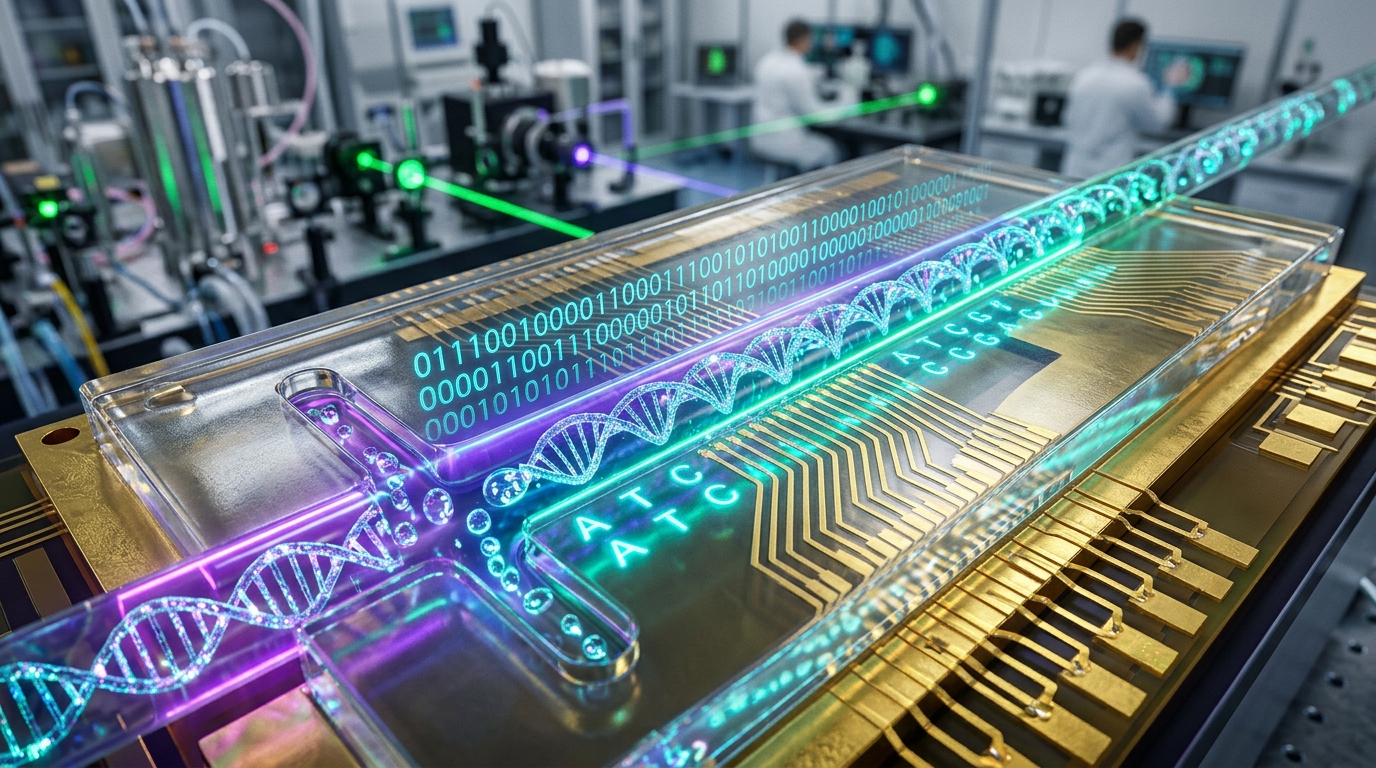
As the global computational sphere generates over 175 zettabytes of enterprise data—propelled by the exponential training corpora of foundation models, high-energy particle physics archives, and genomic catalogs—humanity's physical storage substrate is hurtling toward a resource wall. Magnetic tape drives degrade in 10 to 30 years, optical platters suffer mechanical decay, and hyperscale data centers burn millions of megawatt-hours keeping spinning disks powered. Today, nature's most robust information polymer is breaking into production computing: Enzymatic DNA Molecular Data Storage is officially achieving exabyte-per-gram density, zero-energy room-temperature archival preservation, and millennium-scale durability.
The Archival Storage Crisis: Why Magnetic Tape and Silicon Flash Fall Short
For seventy years, magnetic tape (LTO) has served as the bedrock of deep enterprise archives. However, maintaining massive tape libraries incurs compounding systemic liabilities:
- Rapid Media Obsolescence: Magnetic media degrades due to magnetic flux leakage and tape binder breakdown within two to three decades, requiring constant, expensive "data migrations" to modern hardware formats.
- Physical Volumetric Saturation: Storing an exabyte of digital information on state-of-the-art LTO-9 cartridges demands an entire warehouse facility equipped with robotic tape silos and climate-controlled HVAC chillers.
- Supply Chain Resource Limits: Terrestrial supplies of rare-earth neodymium, ruthenium, and semiconductor-grade silicon cannot scale sustainably to keep pace with the exponential surge in autonomous agent telemetry and scientific simulation data.
The Molecular Paradigm: Storing Bits in Quaternary Biological Polymers
Deoxyribonucleic acid (DNA) is nature's ultra-dense data storage medium, perfected across 3.8 billion years of biological evolution. Rather than storing binary states as electrical charges in capacitive floating-gate transistors, DNA stores digital information as sequences of four chemical nucleotide bases:
{00 → A (Adenine), 01 → C (Cytosine), 10 → G (Guanine), 11 → T (Thymine)}
Because each nucleotide possesses a physical volume of approximately 0.3 cubic nanometers, DNA boasts a theoretical raw data density of 215 petabytes per gram (10^18 bytes in a sugar-cube volume). Furthermore, encapsulated inside microscopic silica beads, synthetic DNA requires zero continuous electrical power and survives without degradation for millennia at room temperature.
Enzymatic Synthesis: Replacing Harsh Organic Solvents with Microfluidic Enzymes
The historical roadblock preventing commercial adoption of DNA storage was chemical synthesis speed and cost. Legacy phosphoramidite synthesis relies on hazardous organic reagents (acetonitrile, trichloroacetic acid) and suffers from high error rates on oligonucleotides longer than 150 base pairs.
The breakthrough enabling production scaling is Enzymatic DNA Synthesis (EDS). Utilizing template-independent polymerase enzymes (specifically Terminal Deoxynucleotidyl Transferase, or TdT), microfluidic flow cells add individual 3'-reversibly blocked nucleotides in benign aqueous buffers at 37°C. By deploying CMOS micro-electrode arrays with thousands of localized reaction chambers, enzymatic synthesis synthesizes thousands of parallel oligonucleotide strands simultaneously at orders-of-magnitude lower cost and energy consumption.
import hashlib
from typing import List, Tuple, Dict

# Standard quaternary nucleotide mapping table
BITS_TO_BASE = {"00": "A", "01": "C", "10": "G", "11": "T"}
BASE_TO_BITS = {v: k for k, v in BITS_TO_BASE.items()}

class MolecularDNACodec:
    """
    High-density digital-to-DNA encoder & constraint verifier.
    Converts raw binary payloads into synthetic oligonucleotides while enforcing
    homopolymer run-length ceilings and GC-content stability for enzymatic synthesis.
    """
    def __init__(self, max_homopolymer: int = 3, target_gc_min: float = 0.40, target_gc_max: float = 0.60):
        self.max_hp = max_homopolymer
        self.gc_min = target_gc_min
        self.gc_max = target_gc_max
        print(f"[*] Initialized Molecular DNA Codec: MaxHP={max_homopolymer} | GC Window=[{target_gc_min:.0%}, {target_gc_max:.0%}]")

    def encode_binary_stream(self, data_bytes: bytes, primer_fwd: str = "ACGTACG", primer_rev: str = "TGCATGC") -> Tuple[str, Dict[str, any]]:
        """Encodes raw binary bytes into a biochemically viable oligonucleotide sequence with PCR primers."""
        # Convert bytes to binary bitstring
        bitstring = "".join(f"{byte:08b}" for byte in data_bytes)
        if len(bitstring) % 2 != 0:
            bitstring += "0"

        # Map 2-bit chunks to nucleotides
        payload_bases = []
        for i in range(0, len(bitstring), 2):
            chunk = bitstring[i:i+2]
            payload_bases.append(BITS_TO_BASE[chunk])

        raw_seq = "".join(payload_bases)

        # Enforce homopolymer smoothing via rotating rotation table if consecutive bases exceed ceiling
        smooth_bases = []
        for base in raw_seq:
            if len(smooth_bases) >= self.max_hp and all(b == base for b in smooth_bases[-self.max_hp:]):
                alt_base = "C" if base in ["A", "T"] else "A"
                smooth_bases.append(alt_base)
            else:
                smooth_bases.append(base)

        payload_oligo = "".join(smooth_bases)
        full_oligo = f"{primer_fwd}{payload_oligo}{primer_rev}"

        # Calculate biochemical stability metrics
        gc_count = full_oligo.count("G") + full_oligo.count("C")
        gc_ratio = gc_count / len(full_oligo)
        density_bits_per_base = (len(data_bytes) * 8) / len(full_oligo)

        metrics = {
            "oligo_length_bp": len(full_oligo),
            "gc_content_ratio": round(gc_ratio, 3),
            "is_gc_compliant": self.gc_min <= gc_ratio <= self.gc_max,
            "density_bits_per_base": round(density_bits_per_base, 2),
            "payload_sha256": hashlib.sha256(data_bytes).hexdigest()[:16]
        }
        return full_oligo, metrics

if __name__ == "__main__":
    codec = MolecularDNACodec()
    sample_text = "PremLal Technologies: Autonomous Molecular Computing & Global Archival DNA Storage"
    oligo_strand, stats = codec.encode_binary_stream(sample_text.encode("utf-8"))
    print(f"[OK] Oligonucleotide Strand Synthesized (First 60 bp): {oligo_strand[:60]}...")
    print(f"[OK] Synthesis Quality & Stability Metrics: {stats}")
Random-Access Retrieval via Barcoding and Nanopore Sequencing
A longstanding criticism of molecular storage was the assumption that reading data required sequencing an entire vat of DNA. Modern molecular architecture solves this through Random-Access PCR Barcoding and high-throughput solid-state nanopore sequencing:
- PCR Primer Addressing: Every synthetic oligonucleotide incorporates unique forward and reverse primer binding sites (20 base pairs each) acting as biological "file paths." To retrieve a specific file, microfluidic dispensers inject matching primer probes, amplifying only the target strand via Polymerase Chain Reaction.
- Real-Time Nanopore Readout: As the amplified DNA molecules are threaded through protein nanopores embedded in synthetic lipid membranes, disruptions in ionic current are translated back into digital bitstreams in real time with zero chemical reagents consumed.
The Horizon: Building Exabyte Cold Storage for the Post-Silicon Age
By uniting synthetic biology with automated CMOS semiconductor control, DNA data storage transitions from science fiction to commercial reality. Global hyperscalers and national archives are already planning hybrid cold-storage tiers where historical archives, model weights, and cultural heritage are stored as molecular pellets inside hermetic capsules.
Requiring zero power, zero cooling, and offering indestructible multi-millennium longevity, DNA molecular storage provides the foundational substrate to preserve human knowledge across deep time.
Verified Peer-Reviewed Literature & Molecular Storage Frameworks
- Nature Biotechnology: Enzymatic DNA Synthesis and High-Throughput Molecular Data Storage (Nature Biotech)
- Science / Science Advances: Scaling DNA Data Storage with Random-Access Primers and Solid-State Nanopores
- ACM International Conference on Architectural Support for Programming Languages and Operating Systems: Architecting End-to-End Molecular Memory Systems: From CMOS Synthesis to Nanopores (ACM ASPLOS)
- IEEE Transactions on NanoBioscience: Error-Correcting Codes and Fountain Droplets for Molecular Digital DNA Storage
- arXiv Quantitative Biology & Information Theory: High-Density Quaternary Channel Coding and Homopolymer Reduction Algorithms
- Open Synthetic Biology Consortium: DNA Fountain & Microfluidic Oligonucleotide Compilation Toolchain