
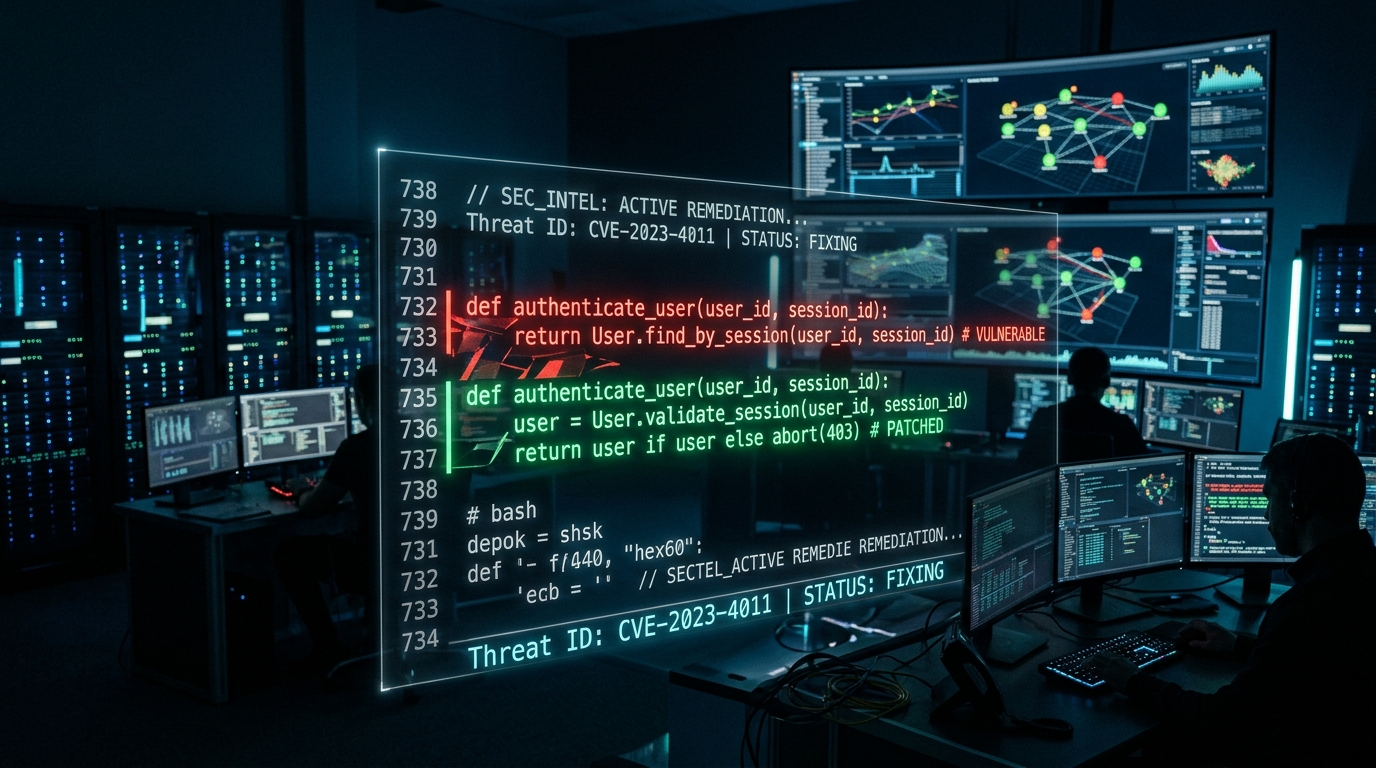
The cybersecurity landscape has crossed an unprecedented threshold. With the public release and open-sourcing of competition-grade Cyber Reasoning Systems (CRSs) developed under the Defense Advanced Research Projects Agency (DARPA) and Advanced Research Projects Agency for Health (ARPA-H) Artificial Intelligence Cyber Challenge (AIxCC), the United States Cybersecurity and Infrastructure Security Agency (CISA) has unveiled aggressive operational directives enforcing autonomous, machine-speed patch synthesis across federal systems and foundational open-source dependencies.
The Architecture of Cyber Reasoning Systems: Neuro-Symbolic Synergy
Traditional vulnerability research has historically relied on a bifurcated paradigm: human security analysts painstakingly auditing Abstract Syntax Trees (ASTs) or deploying brute-force dynamic instrumentation such as coverage-guided fuzzers. The open-sourced AIxCC architectures, pioneered by leading research consortia including Team Atlanta, Trail of Bits, and Theori, dismantle this operational bottleneck by synthesizing Large Language Models (LLMs) with deterministic program analysis into cohesive neuro-symbolic engines.
Modern CRSs operate across tightly integrated feedback loops that elevate fuzzing and dynamic triage beyond probabilistic guessing:
- AI-Directed Grammar and Seed Generation: High-parameter reasoning models ingest project codebases, build systems (e.g., CMake, Bazel, Makefiles), and sanitization logs to construct contextually valid test harnesses and seed corpuses, targeting obscure edge-case branches that traditional mutation engines fail to traverse.
- Guided Dynamic Fuzzing & Sanitizer Instrumentation: Systems integrate LLM-orchestrated fuzz engines (such as AFL++ and LibFuzzer variants) with AddressSanitizer (ASan), MemorySanitizer (MSan), and UndefinedBehaviorSanitizer (UBSan) to flag memory corruption primitives, including use-after-free, out-of-bounds array indexing, and integer overflows.
- Symbolic Execution & Constraint Solving: Upon intercepting an anomalous execution path, CRSs trigger symbolic execution frameworks (e.g., angr, KLEE) combined with SMT solvers like Z3. This isolates path predicates and synthesizes a deterministic Proof of Vulnerability (PoV)—an exploit payload verifying exploitative reachability without false positives.
Automated Patch Synthesis & Regression Testing Pipelines
Discovering an exploitable flaw in machine time solves only half the vulnerability lifecycle equation; remediating the source code without breaking downstream systems represents the harder engineering feat. AIxCC CRSs resolve this through Automated Program Repair (APR) pipelines engineered to execute with minimal human intervention.
When an instrumented crash confirms a reproducible PoV, the CRS isolates the culprit instruction range and invokes specialized code generation models prompted with precise semantic slicing. The patch synthesis loop follows strict verification protocols:
- Semantic AST Patch Generation: The CRS generates candidate diffs targeting root-cause logic flaws rather than naive band-aids (such as arbitrary bounds clamping or suppressing error returns). Candidate modifications are restricted to minimal syntactic transformations to reduce blast radius.
- Differential Execution & Crash Invalidation: Candidate patches are recompiled against the target container. The CRS injects the generated PoV; if the application crashes or triggers sanitizers, the patch candidate is rejected and returned to the reasoning agent with compiler diagnostics and execution traces for iterative refinement.
- Comprehensive Non-Regression Invariant Checks: Surviving candidates undergo extensive differential regression testing against the repository's baseline test suite and dynamically generated invariant checks. This ensures that legitimate functional workflows, latency profiles, and API contracts remain uncompromised.
CISA Secure-by-Design Directives & KEV Alignment
In lockstep with DARPA's code drop, CISA has formalized a binding operational framework integrating autonomous CRSs into the Known Exploited Vulnerabilities (KEV) catalog and the ongoing Secure-by-Design initiative. Historically, mean-time-to-remediate (MTTR) for zero-day and critical Common Vulnerabilities and Exposures (CVEs) has spanned 15 to 45 days—an unacceptably wide exposure window exploited by state-sponsored Advanced Persistent Threats (APTs) and automated ransomware actors.
Under CISA's newly released enforcement framework, critical infrastructure operators and federal agencies managing mission-critical codebases face stringent compliance requirements:
- Machine-Speed Triage Mandates: Within 48 hours of an open-source dependency vulnerability being cataloged or detected in an upstream package, automated CRS pipelines must produce verifiable PoV reproductions and candidate semantic patches.
- Zero-Day Preemption in Critical Software: Continuous integration/continuous deployment (CI/CD) pipelines supporting defense industrial base assets, water systems, power grids, and healthcare infrastructure must incorporate open-source CRS tools (such as OpenSSF's OSS-CRS framework) to proactively uncover and patch latent vulnerabilities prior to public disclosure.
- Audit Trails and Cryptographic Attestation: To mitigate software supply chain integrity risks, all autonomously generated patches must be accompanied by full provenance logs, including sanitizer crash traces, non-regression test coverage matrices, and cryptographically signed in-toto attestations before production deployment.
Empirical Challenges: Overfitting, Semantic Drift, and Formal Verification
Despite profound architectural advances, transitioning fully autonomous patching from sandboxed competition environments to production enterprise topologies introduces formidable challenges. Security researchers caution that automated code repair remains susceptible to distinct failure modes:
- Patch Overfitting (Plausibility vs. Correctness): A persistent dilemma in automated repair is generating "plausible" patches that pass the unit test suite and invalidate the PoV simply by prematurely exiting early or disabling the vulnerable feature path altogether. Without exhaustive test coverage, CRSs can introduce silent semantic drift.
- Hallucination in Complex Concurrency: While LLMs excel at localized memory errors in C and C++, multithreaded race conditions, asynchronous event loops, and distributed consensus flaws often exceed the spatial reasoning windows of current generative models.
- The Shift Toward Formal Verification: To counter these vulnerabilities, next-generation CRSs are actively integrating formal verification tools, including Coq, Lean, and Dafny. By pairing generative code synthesis with mathematically sound theorem proving, automated systems can mathematically verify that a synthesized patch satisfies program specifications and maintains invariant soundness.
As DARPA's AIxCC repositories seed enterprise DevSecOps pipelines and CISA's regulatory framework takes hold, the paradigm of cybersecurity is experiencing its most radical realignment since the advent of public-key cryptography. The era of manual triage against automated adversaries is drawing to a close, replaced by an autonomous cyber defense apparatus operating at the speed of silicon.
Primary Sources & Peer-Reviewed References
- DARPA / ARPA-H AIxCC Archive: AIxCC Cyber Reasoning Systems Open Repositories
- CISA Directives: CISA Secure by Design & Automated Vulnerability Remediation
- IEEE S&P Research: Autonomous Vulnerability Discovery and Semantic Patch Synthesis
- arXiv Computer Science: PatchBench: Evaluating LLM-Driven Software Repair at Machine Scale